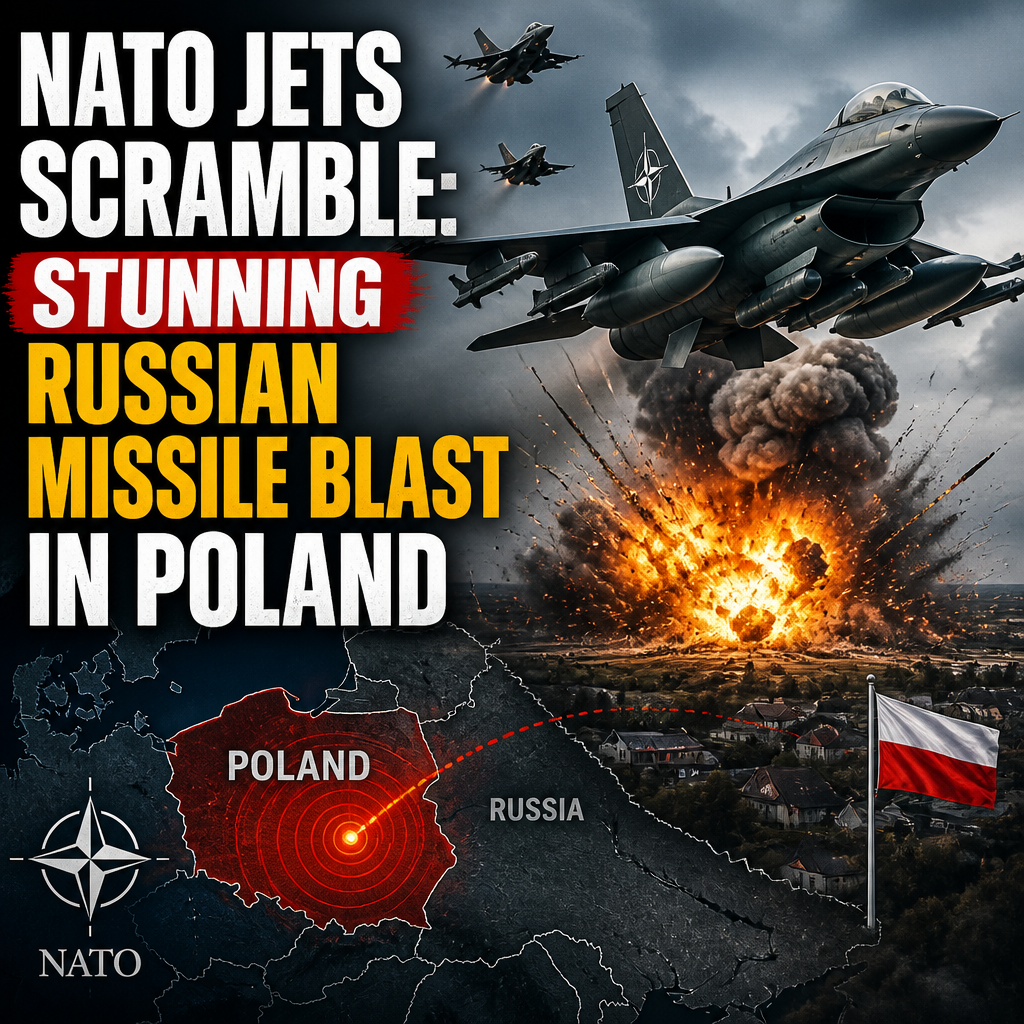
NATO Jets Scramble: Stunning Russian Missile Blast in Poland


NATO jets scramble after reports of a Russian missile detonation in Poland, and the incident has quickly become another test of how fragile security can be along Europe’s eastern flank. What makes the story especially serious is not only the blast itself, but the political and military risk that comes with any event near a NATO border: even a small miscalculation can raise the temperature fast.
What is known — and what still isn’t
Early reports indicated that a missile, believed by some outlets and officials to be Russian, detonated in Polish territory, prompting a swift NATO air response. That alone is enough to alarm governments and publics across Europe. But the most important detail, at least in the first hours after such a report, is whether the missile was intentionally launched into Poland, whether it was a stray projectile from nearby fighting, or whether there was some other technical explanation. Those distinctions matter enormously, both legally and diplomatically.



That uncertainty is part of why this story has drawn such intense attention across newsrooms. Al Jazeera’s coverage tends to frame the event through the lens of escalation risk and the broader regional consequences of Russia’s war. Sky News-style reporting often emphasizes the immediate security response, the NATO angle, and the implications for allied readiness. Russian state-affiliated coverage, by contrast, typically pushes back against claims of direct blame and highlights the possibility of accident, interception debris, or contested attribution.
Taken together, those viewpoints show a common pattern: everyone agrees the event is serious, but not everyone agrees on what it proves.




Why the response was so fast
If a projectile lands in Poland, the reflexive response from NATO members is understandable. Poland is a frontline state in the alliance’s security architecture, and any border incident can trigger urgent military precautions. Scrambling jets is not the same thing as declaring a crisis, but it is a sign that commanders are treating the incident as potentially consequential rather than routine.
The speed of the response reflects lessons from recent years:
– The war in Ukraine has made airspace monitoring a near-constant priority.
– NATO members are wary of appearing slow or uncertain in the face of possible spillover.
– Public trust depends on visible readiness when an event could threaten alliance territory.
Still, rapid response does not necessarily confirm the worst-case interpretation. Air policing often involves acting first and confirming later, especially when early information is incomplete.
NATO jets scramble and the politics of attribution
Attribution is the heart of the controversy. If a missile crossed into Poland directly from Russian forces, that would be a far more serious event than debris falling after interception or a missile straying off course. The legal and political consequences would also be different. NATO would need to assess whether the incident represented an attack, an accident, or an indirect consequence of the war just across the border.
That is why reactions from different media ecosystems matter. Western outlets often stress the risk that Russia’s war could spill beyond Ukraine, especially when missiles or drones move near allied territory. Russian outlets, meanwhile, frequently emphasize ambiguity and urge readers not to jump to conclusions before investigations are complete.
This split is not just about propaganda; it also reflects the real challenges of verifying battlefield-related incidents. In an age of instant video clips, social media posts, and conflicting statements, a dramatic image can travel faster than evidence. That makes careful reporting essential.
The broader stakes for Europe
Even if the final assessment shows the blast was accidental or caused by debris, the political meaning would remain significant. Poland and other NATO states are living with a new normal in which proximity to war carries real risk. Air defenses, missile warning systems, and alliance coordination are no longer abstract strategic concepts; they are daily realities.
There are several reasons this incident resonates beyond Poland:
– It tests NATO’s ability to respond calmly but firmly.
– It underscores how vulnerable border states are to spillover from the war in Ukraine.
– It increases pressure on policymakers to communicate clearly without overreacting.
– It reminds the public that “containment” is harder when modern weapons can travel quickly and unpredictably.
At the same time, there is a danger in letting every unexplained military incident become a pretext for escalation. A responsible response requires firmness, but also discipline. If early reports are later revised, that should not be treated as weakness; it should be seen as the result of evidence-based assessment.
A sober conclusion
The most balanced reading of the reports is this: the event is alarming, but the full picture is still developing. NATO’s fast response makes sense in a high-risk environment, and Poland’s concern is entirely justified. But until investigators establish exactly what happened, where it came from, and whether it was intentional, sweeping conclusions would be premature.
What this episode does make clear is that the war in Ukraine continues to create dangerous edges where misunderstanding, misfire, or miscalculation could have consequences beyond the battlefield. That is why measured language matters so much. In moments like this, the goal should not be to amplify fear, but to understand the facts quickly and accurately enough to prevent the next crisis from starting before the last one is even explained.